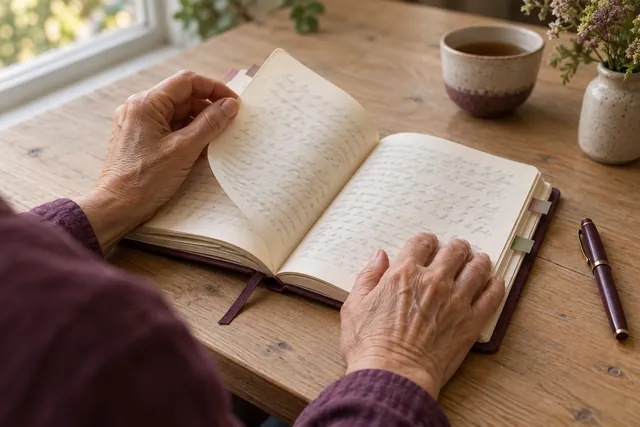
Looking back at what you’ve written
You open an earlier entry and recognise the sentence before you have finished reading it. You wrote something much like it a few entries later. Perhaps the same question appears in a message you saved. Seeing it again, you might think, I’m still doing this.
That may be something the record shows. It may also be the first part you notice. Before deciding what it says about you, there is room to look at the moments themselves.
Begin with a small part of the record
You do not need to read the whole journal each time you look back. A few entries, or the ones gathered for a Review, may give you enough to consider. Choose a point where you can stop. If nothing stands out, there is no need to keep reading until it does.
The questions in the Journal give you places to begin: what happened, the meaning you gave it and what you did next. Reading those parts beside each other can help you describe the sequence more precisely.
Keep the event and its meaning separate
For example, an entry might say, I sent a message and there was no reply. The meaning written beside it might be, They don’t want to talk to me. The next action might be, I checked my phone again ten minutes later.
The entry records the lack of a reply at that point, your interpretation and what followed. It does not establish why the other person had not replied. Your interpretation may have felt completely convincing when you wrote it. You can recognise that without treating it as a fact about them.
Looking back does not require replacing it with a reassuring explanation either. I did not know why there was no reply may be the most accurate thing you can say.
Describe what repeats as closely as you can
If several entries contain a similar sequence, try keeping the observation close to those entries. In these three entries, I checked again while waiting for a reply tells you more than I always do this. It names what you recorded and leaves room for what you did not.
The similarity may be in the situation, the meaning you gave it or the action that followed. Those do not have to repeat together. Different events might bring up the same thought. The same event might be followed by different choices on different days.
You may see a possible connection without knowing what explains it. That is a place to leave a question open.
Look for differences too
Perhaps one entry shows you reopening the app several times. In another, you noticed the urge and carried on with the conversation you were having. Or the action was the same, but the meaning you gave the moment was different.
These differences do not have to prove progress. They help you see the range of what happened. If one occasion felt easier, it may be worth noticing what else was present: where you were, who was with you or what had your attention. One example cannot tell you that any of those things caused the difference or will do so again.
There may also be entries that look much the same. You can record that without finding a hidden improvement.
Read the numbers beside the words
The number you chose records how much attention that moment seemed to take at the time. A lower number is not a mark for behaving well, and a higher one does not cancel an earlier entry.
Two entries with the same number may describe very different experiences. Read what was happening around each number before deciding what the comparison means. If a rating now seems surprising, it still records the answer you gave then.
Remember what the journal cannot show
Your entries are the moments you chose to write about. They are not a complete account of every hour. If you mainly opened the Journal when something was difficult, the record will contain more of those moments.
A blank day does not tell you whether checking happened. Fewer entries do not necessarily mean fewer urges. Equally, writing about something more often may mean you are noticing or recording it more, rather than doing it more. The record can help you ask clearer questions, but it cannot fill in the parts you did not write down.
If you return to a saved message
A message may show what you wanted to ask, explain or say at that time. Later, the same words may still matter. You may want to say something different, or no longer want to send anything.
A repeated question is something you can notice. It does not reveal what the other person thinks, and saving the message does not commit you to sending it. You can leave it as a record of what you wanted to say then.
Leave room for an unfinished observation
After reading, one sentence may be enough: Waiting for a reply appears in several entries. Or, The situations are similar, but I did something different twice. Or simply, I cannot see a clear pattern yet.
If you want to try something next time, it can remain a small possibility. The record does not have to produce a new rule. You can also close the Journal without deciding what to do.
If rereading becomes a way of repeatedly judging yourself, or feels too much today, you can stop. The entries will still be there when you choose to return. You do not have to reach a conclusion before closing the page.